NEXUS Card vs Passport: Your 2026 Travel Guide
NEXUS Card vs Passport: Your 2026 Travel Guide

If you cross the U.S.–Canada border regularly, you have two main options: a NEXUS card or a U.S. passport. The short answer is that a NEXUS card works for land, air, and sea travel between the U.S. and Canada, but a passport remains the stronger document because it proves citizenship globally and covers every travel scenario. The NEXUS card is a trusted traveler credential, not a replacement for your passport.
| Criteria | NEXUS Card | U.S. Passport |
|---|---|---|
| Acceptance locations | U.S.–Canada border crossings, designated airports, marine ports | Worldwide |
| Purpose | Expedited border processing for pre-screened travelers | Proof of citizenship and identity for all international travel |
| Legal status | Trusted traveler credential (WHTI-compliant) | Full legal citizenship document |
| Application process | Background check, in-person interview, dual U.S.–Canada approval | Application form, photo, supporting documents, no interview |
| Cost | $120 USD per adult, valid 5 years | — |
| Validity | 5 years | 10 years (adult), 5 years (child) |
| Travel convenience | Dedicated lanes, TSA PreCheck, Global Entry kiosks | Standard lanes; no automatic expedited processing |
NEXUS card quick pros and cons:
- Pros: Faster border crossings, TSA PreCheck access, Global Entry kiosk use at Canadian preclearance airports, lower cost per year than a passport renewal
- Cons: Only useful for U.S.–Canada travel, requires an in-person interview, can be revoked, not valid for travel outside North America
U.S. passport quick pros and cons:
- Pros: Accepted worldwide, proves citizenship in every legal context, no interview required, cannot be revoked like a program membership
- Cons: No expedited lane access, standard processing times at the border, higher renewal cost
Government guidance from U.S. Customs and Border Protection is clear: even if you hold a valid NEXUS card, you should always travel with your passport or proof of permanent residence in case you need to verify your citizenship status.
What is the NEXUS card and who actually benefits from it?
The NEXUS program is a joint initiative run by U.S. Customs and Border Protection (CBP) and the Canada Border Services Agency (CBSA). It pre-screens travelers so they can move across the border faster, with less friction at every crossing type.
The program is built for people who cross between the U.S. and Canada often, whether for work, family, or frequent leisure travel. If you cross the border a handful of times a year, the time savings add up quickly. NEXUS members skip the standard inspection lines and use dedicated processing lanes at land crossings, NEXUS kiosks at multiple major Canadian airports, and Global Entry kiosks at some Canadian airports when entering the U.S.
Core NEXUS card benefits:
- Dedicated vehicle lanes at 18 designated land border crossings
- NEXUS kiosks and eGates at several major Canadian international airports
- Global Entry kiosks at some Canadian airports for U.S. entry
- TSA PreCheck access at numerous participating U.S. airports
- Expedited CATSA security screening lines in Canada, where available
- Faster processing at all marine crossings
The traveler who gets the most value from NEXUS is someone who crosses the border at least several times a year and wants to cut wait times at both ends. Business travelers commuting between cities like Toronto and New York, or families with relatives on both sides of the border, are the clearest beneficiaries.
NEXUS card eligibility and how to apply
Who can apply
Eligible applicants include U.S. citizens, U.S. lawful permanent residents, Canadian citizens, Canadian lawful permanent residents, and Mexican nationals who are members of Mexico’s Viajero Confiable trusted traveler program. Applicants under 18 must have a parent or legal guardian’s consent to participate.
Both the U.S. and Canada must approve your application. If either country denies you, you cannot join the program.
The application process
- Create an account on the Trusted Traveler Programs (TTP) website at ttp.dhs.gov and complete the online application.
- Pay the fee. The application fee is $120 USD per adult and is non-refundable. Children under 18 may apply free of charge if eligible.
- Wait for conditional approval. CBP and CBSA review your background, criminal history, and immigration records.
- Schedule and attend an in-person interview at a NEXUS enrollment center. Both countries must conduct this interview jointly.
- Receive your card. Once approved, your membership is valid for five years.
| Item | Detail |
|---|---|
| Application fee (adult) | $120 USD, non-refundable |
| Children under 18 | Free if eligible |
| Validity period | 5 years |
| Interview required | Yes, in-person at an enrollment center |
| Approving authorities | U.S. CBP and Canada CBSA (both must approve) |
Documents you need to bring to your interview include a valid passport (all valid passports if you hold more than one), proof of residency such as a utility bill or driver’s license, and a permanent resident card if applicable.
The biggest practical hurdle is scheduling that interview. In-person interview requirements mean applicants who live far from an enrollment center face real logistical challenges. Wait times for interview slots can stretch from months to over a year at busy locations.
Pro Tip: Don’t wait for a convenient slot to appear on your own. Services like Globalentrypriority monitor all 151 U.S. Trusted Traveler enrollment centers every minute and send you an instant SMS alert the moment a slot opens up, so you can book it before anyone else does. Most travelers who use this approach lock in an interview within 10 days.
For more on how to handle the scheduling side, the NEXUS program guide at Globalentrypriority covers the full picture.
How to use your NEXUS card at land borders and airports
At land border crossings
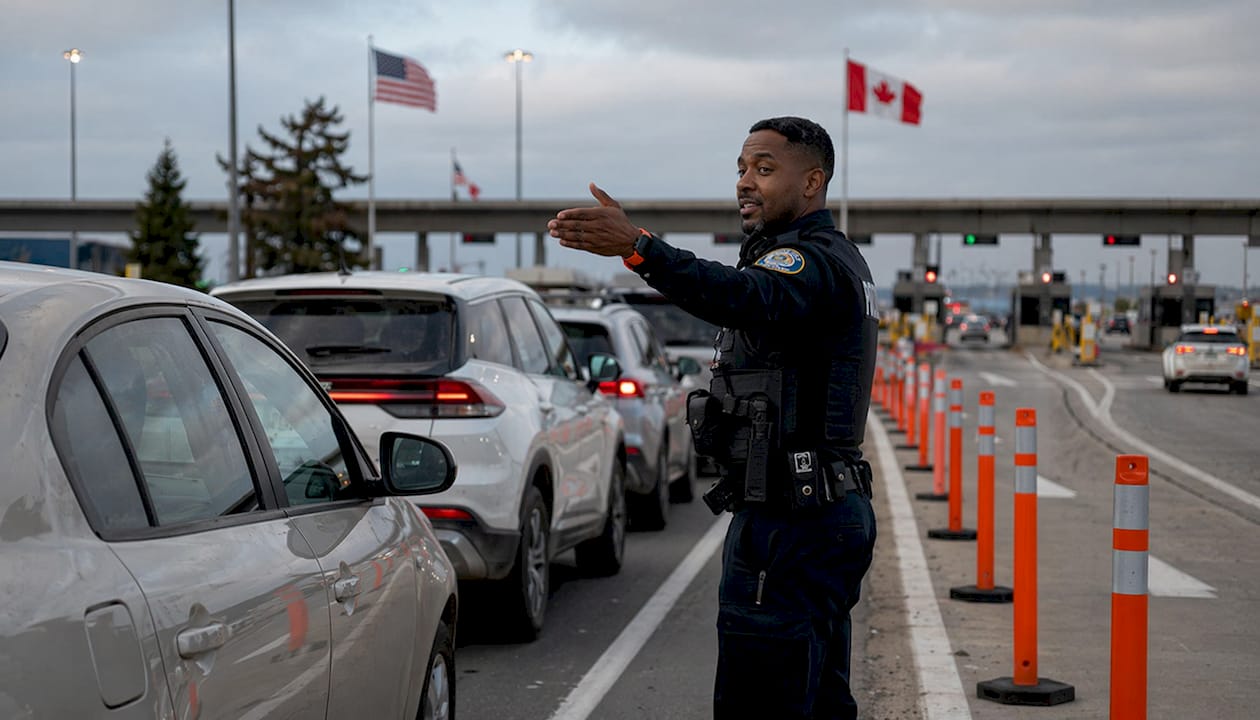
Pull into the dedicated NEXUS lane at designated land crossings. Your NEXUS card uses radio frequency identification (RFID) technology, so the system reads your card as you approach. You answer a few brief questions and move through faster than the standard inspection line.
At Canadian airports
At 9 designated Canadian airports, you can use NEXUS kiosks and eGates for entry into Canada. The eGate uses facial verification and processes one traveler at a time. Children under 14 cannot use eGates but can use kiosks.
When entering the U.S. from Canada, Global Entry kiosks are available at 8 Canadian airports with preclearance facilities. You scan your NEXUS card, answer the customs declaration questions, and receive a receipt to hand to the officer.
At marine ports
NEXUS members can report arrival into the U.S. and Canada by calling a marine telephone reporting center rather than docking at a staffed port. The CBSA also covers over 400 marine reporting sites across Canada.
Practical tips for NEXUS card users:
- Bring your passport on your first kiosk use. The system will prompt you to upload your passport photo, and without it, you cannot use the kiosk and must go through manual identity verification.
- Keep your NEXUS card accessible, not buried in your bag. RFID readers at land crossings work best when the card is held up clearly.
- If the NEXUS kiosk or eGate is closed, use the special services counter or, if you have your passport, a primary inspection kiosk.
- Always carry your passport alongside your NEXUS card for air travel in case your flight diverts to a non-preclearance airport.
Pro Tip: Your NEXUS card also gives you TSA PreCheck access at over 200 U.S. airports. Enter your NEXUS card number as your Known Traveler Number when booking flights to activate this benefit automatically.
NEXUS card vs U.S. passport: a side-by-side comparison
The core difference comes down to scope. A NEXUS card is a trusted traveler credential built for one specific corridor. A U.S. passport is a globally recognized legal document that proves citizenship in every country on earth.
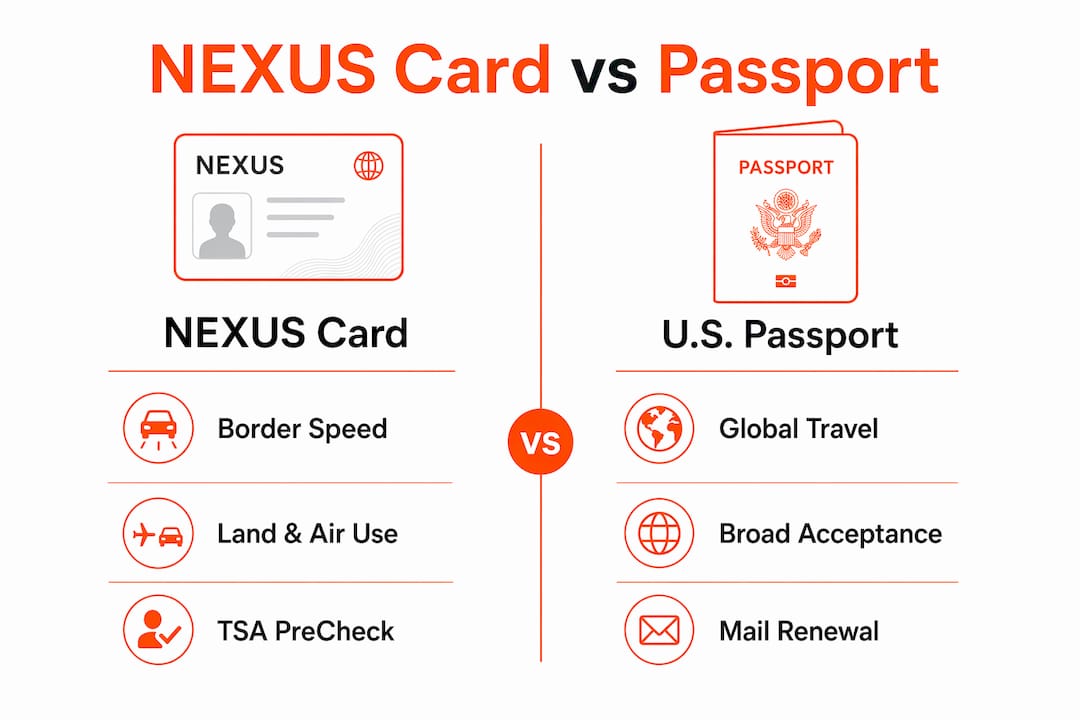
| Criteria | NEXUS Card | U.S. Passport |
|---|---|---|
| Acceptance locations | U.S.–Canada border, designated ports | Worldwide |
| Purpose | Expedited processing for vetted travelers | Legal citizenship and identity proof |
| Legal status | WHTI-compliant trusted traveler credential | Full citizenship document |
| Cost | $120 USD / 5 years | — |
| Validity | 5 years | 10 years (adult) |
| Application requirements | Background check, in-person interview | Application form, photo, supporting docs |
| Travel convenience | Dedicated lanes, TSA PreCheck, Global Entry | Standard lanes, accepted everywhere |
Key takeaways from this comparison:
- A NEXUS card gets you through the U.S.–Canada border faster, but it does not replace a passport for any other international travel.
- A passport proves citizenship in every legal context. A NEXUS card does not.
- NEXUS membership can be revoked if you violate program rules. A passport cannot be revoked in the same way.
- For air travel, a NEXUS card is valid between the U.S. and Canada, but you should carry a passport in case of flight diversions or technical issues at the kiosk.
- TSA PreCheck and Global Entry access come with NEXUS at no extra cost, which adds real value for frequent flyers.
If you only ever travel between the U.S. and Canada, a NEXUS card covers your border crossings. But most frequent travelers hold both, using NEXUS for speed and the passport as a backup and for any travel beyond North America. For a deeper look at how NEXUS stacks up against other trusted traveler options, the NEXUS vs Global Entry comparison at Globalentrypriority is worth reading.
Limitations you need to know before relying on your NEXUS card
A NEXUS card is not a full substitute for a passport, and there are specific situations where relying on it alone will create problems.
Geographic limits for airport use. Global Entry kiosks outside Canadian preclearance locations do not accept NEXUS cards. At those kiosks, you need a passport or U.S. Lawful Permanent Resident card. This matters if you are connecting through a U.S. airport that does not have Canadian preclearance.
First-time kiosk use requires your passport. On your first passage through a NEXUS kiosk or eGate, the system prompts you to upload your passport photo. If you do not have your passport with you that first time, you cannot use the kiosk and must have your identity verified manually by an officer.
Travelers who must carry a passport regardless:
- Travelers flying to any destination outside the U.S. or Canada
- Dual nationals who need to show citizenship documentation beyond the NEXUS card
- Travelers whose flights may divert to airports without NEXUS-designated lanes
- Travelers in situations where an officer requests proof of citizenship or permanent residence
NEXUS is a privilege, not a right. The program can be revoked if you are found to have violated its conditions, such as failing to declare goods or being convicted of certain offenses. A passport, by contrast, is a citizenship right that cannot be withdrawn in the same way.
Pro Tip: Always pack your passport even when you plan to use your NEXUS card. Government guidance from both CBP and CBSA specifically recommends this, and it takes up no extra space in your bag.
Security and privacy: how NEXUS and passport protection compare
Both documents use security technology, but they work differently and carry different privacy implications.

A U.S. passport contains a chip that stores your biographic data and a digital photo, protected by Basic Access Control (BAC) encryption. The chip can only be read when the passport is physically open and scanned at an authorized reader. This limits unauthorized remote reading.
A NEXUS card uses RFID technology, which allows it to be read at a distance, specifically to speed up lane processing at land crossings. The tradeoff is that RFID cards can theoretically be scanned without your knowledge if you do not use a shielded wallet or sleeve. CBP encrypts the data on the card, but many frequent travelers still use RFID-blocking sleeves as a precaution.
From a data perspective, NEXUS enrollment involves a deeper background check than a passport application. CBP and CBSA collect biometric data including fingerprints and iris scans during your enrollment interview. This data is stored in government systems and used for identity verification at kiosks and eGates. Passport applications collect a photo and biographical data but do not require biometrics like iris scans.
The practical privacy difference: a passport gives you less biometric exposure but slower border processing. A NEXUS card gives you faster crossings in exchange for more biometric data on file with two governments.
How to renew or replace your NEXUS card versus renewing a passport
Renewing your NEXUS card
NEXUS membership lasts five years. You can apply to renew through the TTP website before your card expires. The renewal process mirrors the initial application: you submit an updated application, pay the $120 USD fee again, and may need to complete another in-person interview depending on your circumstances. CBP and CBSA both review your renewal, and either country can deny it.
If your card is lost or stolen, report it immediately through the TTP portal. A replacement card requires a new application and fee. You will not be able to use NEXUS lanes or kiosks until your replacement card arrives, so carry your passport as your primary travel document in the meantime.
The same interview scheduling challenge applies at renewal. Slots at enrollment centers fill up fast, and waiting months for an appointment means months without your NEXUS benefits. Using an alert service like Globalentrypriority to catch open slots as they appear can cut that wait dramatically.
Renewing a U.S. passport
Adult passports are valid for 10 years. Renewal does not require an in-person appointment in most cases. You mail your current passport, a new photo, the DS-82 renewal form, and the renewal fee to a passport acceptance facility. Processing times vary, but no interview is required. If your passport is lost or stolen, you report it to the State Department and apply for a replacement, which does require an in-person appointment at a passport agency or acceptance facility.
The key difference: passport renewal is largely a mail-in process with no interview. NEXUS renewal may require you to appear in person again, and the scheduling bottleneck is the same one you faced the first time around. For scheduling tips that apply equally to NEXUS and Global Entry renewals, the Global Entry interview guide at Globalentrypriority walks through the process in detail.
Get your NEXUS interview faster with Globalentrypriority
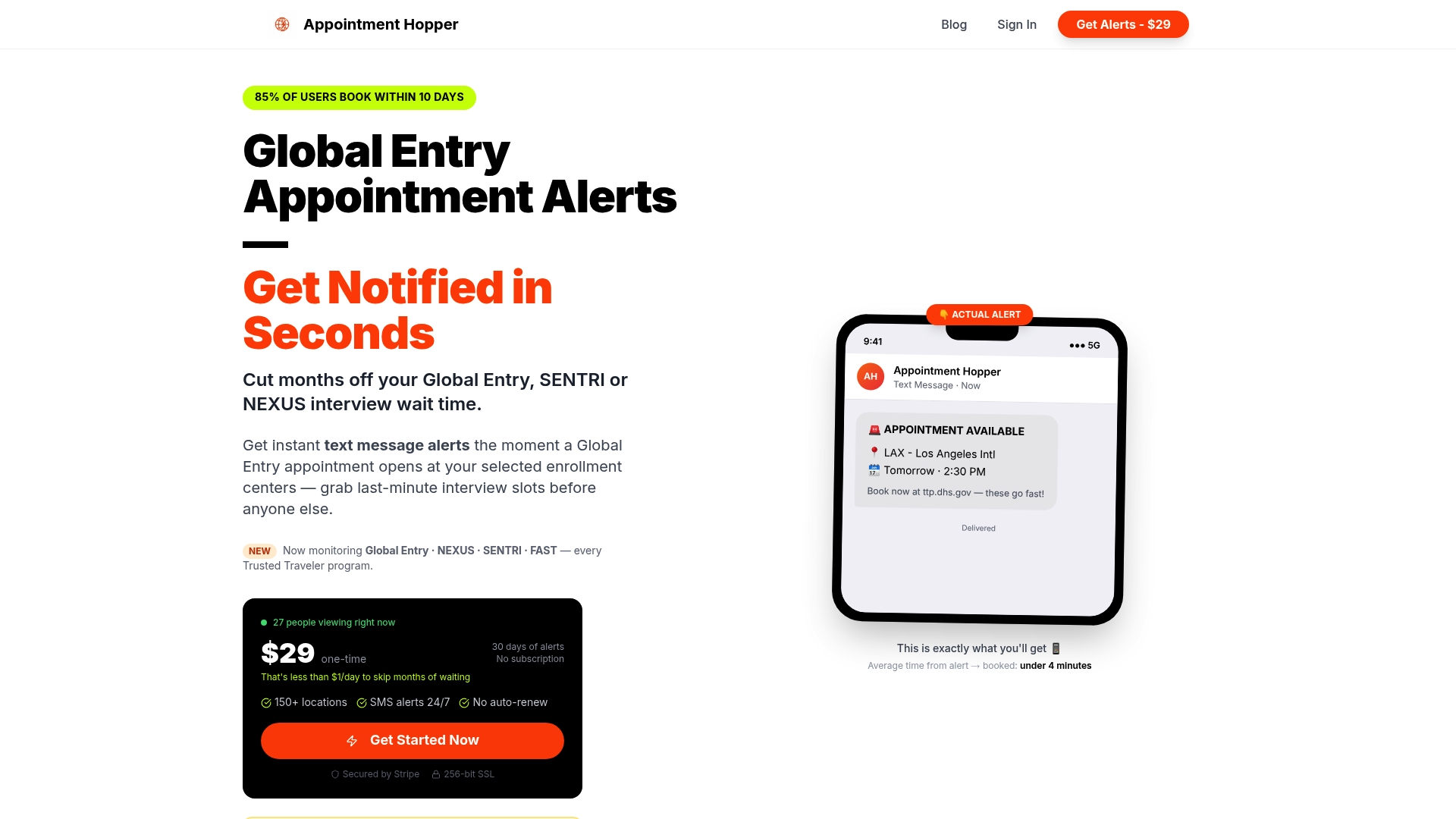
The NEXUS card is worth having. The interview wait is not. Globalentrypriority monitors all 151 U.S. Trusted Traveler enrollment centers every minute and sends you an instant SMS the moment a slot opens at your chosen locations. You pick up to 3 centers, pay a one-time fee of $29 for 30 days of alerts, and get a direct link to the official booking site the second a slot appears. No subscription, no auto-renew, no manual refreshing. Most travelers who use Globalentrypriority’s alert service book their interview within 10 days.
Key Takeaways
A NEXUS card speeds up U.S.–Canada border crossings significantly, but a U.S. passport remains the only document that proves citizenship globally and covers every travel scenario.
| Point | Details |
|---|---|
| NEXUS card scope | Valid for U.S.–Canada land, air, and sea travel only; not accepted for international travel beyond North America. |
| Passport is still required | CBP and CBSA both advise carrying your passport even when you hold a valid NEXUS card. |
| NEXUS cost and validity | The application fee is $120 USD per adult, non-refundable, with membership valid for five years. |
| Airport kiosk limits | NEXUS cards work at Global Entry kiosks only at Canadian preclearance airports, not at other U.S. ports of entry. |
| Interview scheduling | NEXUS requires an in-person interview; using an alert service like Globalentrypriority can cut the wait to around 10 days. |
Recommended
Ready to Find Your Global Entry Appointment?
Get instant SMS alerts when slots open. Most users book within 10 days.
Start Alerts - $29 One-Time